End-of-Shift Charting: Why Late Narratives Are the Weakest Ones
Late charts are the weakest charts. Why end-of-shift charting costs you accuracy, time, and overtime — and how to draft the narrative before the rig clears.
By vitalvoice Team
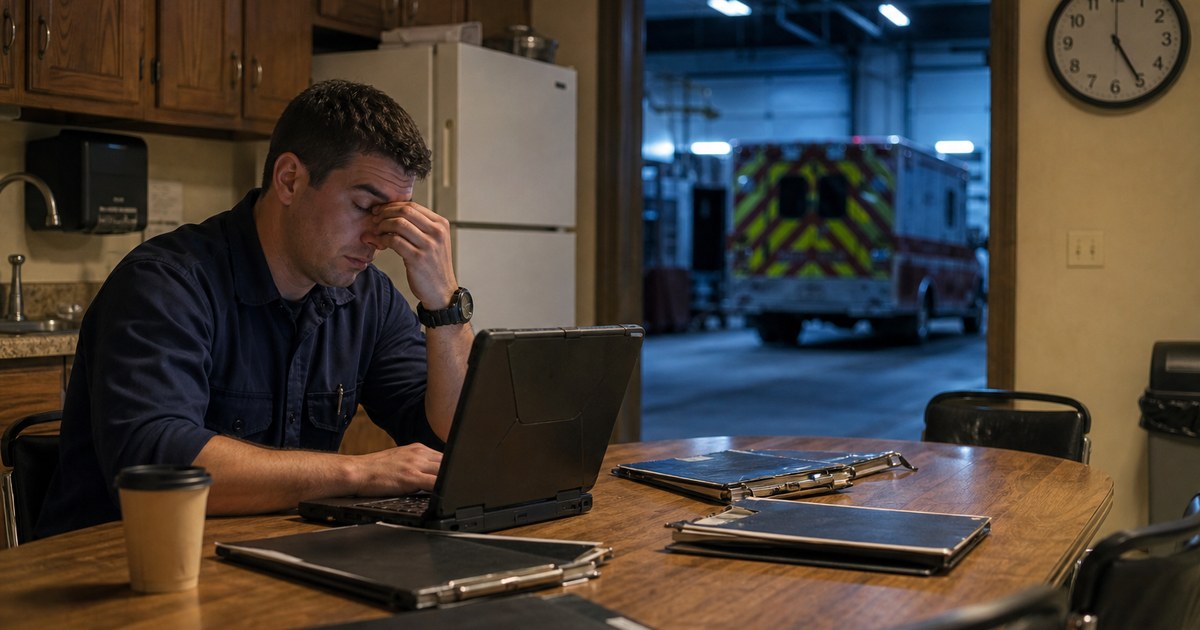
It’s hour 47 of a 48-hour shift. You have four charts open at the kitchen table. Now you are trying to remember a call from 0300.
Two patients had chest pain. One had a blood pressure of 132/84. You think it was the second one.
Every crew knows this scene. The calls came back to back. The charts piled up.
Now you are writing them from memory at the end of the shift. No one planned it this way. It happens when the tones drop before you finish the last report.
The chart you write at hour 47 is not as strong as the one you could have written at hour 3. You are not careless. The workflow made the chart wait while you kept running calls.
Memory fades faster than you think
A call has hundreds of small details. Skin signs. The patient’s exact words.
What the daughter said in the hallway. Which medicine bottle sat on the counter. The details may feel clear when you get back in service.
Then you run the next call. And the next. By shift end, the details have started to blend.
Two similar patients can become one blurry patient. You remember that someone refused transport. You remember a set of vitals. Your brain may put them together, even if they came from different calls.
Small details often fade first. This includes pertinent negatives, or important symptoms the patient did not have.
No chest pain. No shortness of breath. No loss of consciousness.
Times get rounded. You write “about 0315” because you cannot remember if it was 0311 or 0322. Exact quotes become summaries.
That is not dishonest. It is how memory works after 20 hours awake.
A late chart is easier to challenge
QA reviewers can spot a report written later from memory. The time is vague. Important negatives are missing. The assessment does not match the vitals.
Three charts from one shift use the same wording. These reports may get flagged. Then you must rewrite a call you remember even less clearly.
The bigger problem comes if someone reviews the call later. A narrative written on scene is a record made at the time. One written ten hours later is a memory of the call.
An attorney can see the timestamp too. The medic, care, and call are the same. But the earlier record stands up better under questions.
Good charting habits help. Our guide on how to write an EMS narrative covers report structure. Our guide to patient refusal documentation covers refusals.
But a good format cannot fix poor timing. A well-formatted chart is still weak if it comes from a fuzzy memory.
What it costs the crew
Late charting costs more than accuracy. It also costs hours.
An extra hour of reports means overtime for the department. It is also an hour you do not get back. When this happens often, it starts to feel like part of the job.
The calls are not the only burden. The hours of work after the calls matter too.
Being tired creates another problem. You want to finish fast, not write your best report. Rushed charts leave out details.
Thin charts get flagged. Flagged charts get rewritten. You pay for the same report twice.
”Chart as you go” is good advice that’s hard to follow
Every training officer says it: chart while the call is fresh. Write the narrative before you clear the scene.
The advice is right. Following it is hard.
To type during care, you must take your hands and eyes off the patient. You should not make that trade on a real call. Your attention belongs on the person in front of you.
So the chart waits through the ride, wall time, and the next call. Soon, it is hour 47.
The problem is not discipline. It is the tool. Typing and patient care need the same attention. Patient care wins every time.
Change the timing, not the effort
The fix is not to work harder at shift end. Capture the call while it happens, without stopping to type.
Ambient Scribe listens during the call. It drafts the narrative in your department’s exact template, including its sections, headings, terminology, and call-type rules. If your department does not already have a defined template, SOAP, DCHART, and CHART are available as starter formats. The draft is ready before the rig clears the scene.
Details are captured while they are facts, not memories. Times are real times. Pertinent negatives are included when someone says them out loud. You do not have to rebuild them from memory.
For charts already piled up, Smart Dictation helps clear the backlog between calls. Tell the story as you would tell your partner. You get a draft in the right format. Five minutes at the station beats an hour at the kitchen table.
In both cases, you review, edit, and sign the draft. The medic owns the chart. Nothing goes to the electronic patient care report (ePCR) until you read it.
The app works offline in basements and on rural roads. It is HIPAA-compliant with a signed Business Associate Agreement (BAA). Transcripts stay on the device. They wipe at the end of your shift and never touch our servers.
Complete the call, not the paperwork.
Quick answers
Why are late EMS narratives weaker than ones written on scene? Memory fades and calls blend together. Important negative findings get missed, and exact times become guesses. A chart written hours later is a memory, not a record made at the time.
How can EMS crews chart faster without cutting corners? Start the draft earlier. Ambient Scribe drafts the narrative during the call. Smart Dictation turns a spoken account into a clear draft, so the medic does not have to type it from memory at shift end.
Does the medic still control what goes in the chart? Yes. vitalvoice produces a draft only. The medic reviews, edits, and signs every narrative before it reaches the ePCR.
Crews: Download vitalvoice from the App Store. Use a free session on a real call, then decide if it saves you time. The app is rated 5.0, and our pilot crews gave it a 95% Net Promoter Score (NPS). Pilot departments in Colorado are using it now.
Chiefs and training officers: Book a 15-minute demo if late charts are showing up in quality reviews or overtime. We will show you how the narrative can start on scene.