
How to Write an EMS Narrative (With Real Examples)
A plain guide to writing an EMS narrative that holds up in QA and in court: formats, what to include, a full DCHART example, and mistakes to avoid.
By vitalvoice Team
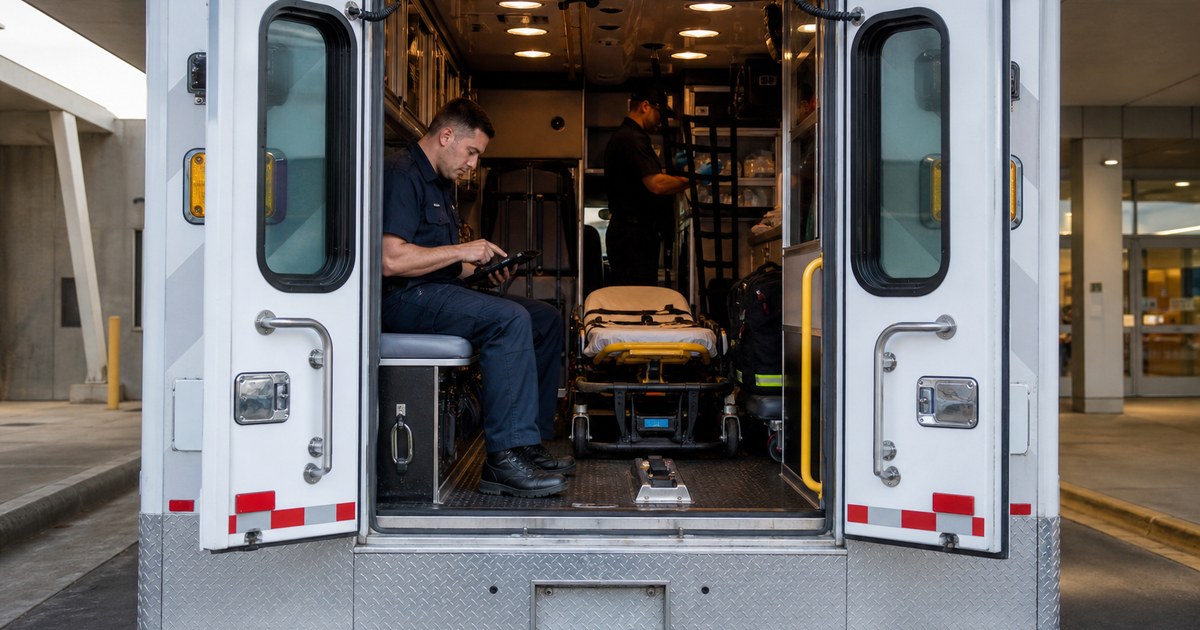
It is the end of the shift. The truck is clean. You have three charts left. The narrative box is blank and blinking at you.
Most of the electronic patient care report (ePCR) is boxes and menus. The narrative is the part you must write. It may be read years later by people who were not there.
Here is how to write a clear narrative that holds up in review.
Why the narrative matters more than the boxes
The checkboxes show what you did. The narrative explains why you did it.
Three groups may read it:
- Your quality assurance (QA) officer checks that care matched protocol.
- The hospital uses it to continue the patient’s care.
- An attorney may use it to build a timeline of a call you barely remember.
That is where the old line comes from: if it isn’t documented, it didn’t happen. It is not a threat. It is how records work. You may have done a full neurologic exam to check the patient’s brain, nerves, strength, and sensation. If it is not in the chart, no one can prove it two years later, including you.
A good narrative also helps protect the patient. The receiving nurse gets a clear account instead of a story passed from person to person.
Pick a format and stick to it
Departments use different formats. Your department likely has one. Use it on every call so you do not skip a section.
The common ones:
- SOAP — Subjective, Objective, Assessment, Plan. It comes from clinical medicine and is widely taught.
- CHART — Chief complaint, History, Assessment, Rx (treatment), Transport. Very common in EMS.
- DCHART — CHART with a Dispatch section first. It starts the story when the call comes in.
- DRAATT — Dispatch, Response, Arrival, Assessment, Treatment, Transport. Heavier on the response phase.
No one format is better than the others. Each one is a container that helps you remember every part of the call.
If your department has not picked one, choose one and use it every time. A consistent chart is easier to write and review.
What a strong narrative contains
Every strong narrative needs the same basic parts.
Facts, not guesses. Write what you saw, heard, measured, and did. “Patient found seated on floor next to bathtub” is a fact. “Patient slipped getting out of the tub” is a guess unless the patient told you that.
Times. Include dispatch, arrival, patient contact, each set of vital signs, each treatment, transport, and hospital arrival. Times turn the call into a clear timeline.
The patient’s own words. Put their words in quotes. “It feels like somebody’s sitting on my chest” tells the reader more than “patient reports chest pressure.” Quote family members too when their words matter.
Pertinent negatives. These are important signs or symptoms you checked for but did not find. For example: no loss of consciousness (LOC), no neck or back pain, and no nausea. These details show what you checked. They are often missing from weak charts.
Your reasoning, within your role. You can state your field impression and why you chose a treatment. Do not write a diagnosis you are not licensed to make. Write “suspected fracture,” not “fractured radius,” unless the diagnosis has been confirmed.
No personal opinions. Leave out how you felt about the patient, family, neighbor, or dispatch. In court, someone may ask you to defend any opinion you include.
An example: simple fall, arm injury
Example for illustration only. Identifying details have been removed. DCHART format.
D: Dispatched at 1412 to a private residence for a fall with arm injury. Responded non-emergent per dispatch. On scene 1419.
C: 68-year-old female, alert, seated on the kitchen floor. Chief complaint of right forearm pain. Patient states, “I caught my foot on the rug and went down on my hand.”
H: Patient reports mechanical trip and fall from standing height onto a linoleum floor, landing on her outstretched right hand. Denies loss of consciousness, dizziness before the fall, chest pain, shortness of breath, head strike, and neck or back pain. No blood thinners. History of hypertension and hypothyroidism. Allergic to sulfa. Family present, reports patient was normal prior to the fall.
A: Patient alert and oriented x4 on contact at 1421. Skin warm and dry. Airway patent, breathing unlabored, radial pulses present bilaterally. Right forearm with obvious deformity and swelling mid-shaft, no open wound, no bleeding. Distal pulse, motor, and sensation intact in the right hand before and after splinting. Pain 7/10, described as “sharp,” worse with movement. Head, neck, back, chest, abdomen, pelvis, and remaining extremities assessed with no deformity or tenderness. Vitals at 1424: BP 148/86, HR 92, RR 18, SpO2 97% on room air, CBG 104. Vitals at 1442: BP 142/84, HR 88, RR 16, SpO2 98%.
R: Right forearm immobilized with a padded rigid splint at 1428, sling applied. Cold pack placed over the injury site. PMS rechecked post-splinting, unchanged. Patient declined pain medication, stating, “I’d rather just get it looked at.” Patient assisted to the stretcher via a two-person lift, secured with all straps.
T: Transported non-emergent at 1436, position of comfort, semi-Fowler’s. Reassessed en route, no change in condition or PMS. Arrived at the receiving facility at 1451. Report given to the charge nurse, care transferred without incident. Patient signature obtained.
The sample is not fancy. It gives times, facts, quotes, important negatives, and a clear handoff.
Example shorthand: BP means blood pressure; HR means heart rate; RR means breathing rate; SpO2 means blood oxygen level; CBG means blood sugar; and PMS means pulse, movement, and sensation past the injury.
Common mistakes
Vague filler. “Patient resting comfortably.” “Patient tolerated transport well.” These phrases sound useful but give no clear detail. Replace them with what you saw.
Copy-paste templates. A saved block may say every arm and leg was checked when that did not happen. A lawyer may read that sentence aloud during sworn questioning.
Charting from memory hours later. A chart written at 6:30 a.m. after a busy night may miss details. Memories fade fast. Exact times often fade first.
Contradicting your own boxes. If the narrative says you did a 12-lead ECG but the checkbox does not, the whole chart may be questioned.
Where vitalvoice fits
The hardest part may not be knowing what to write. It may be starting with a blank page at hour 13.
vitalvoice’s Ambient Scribe listens during the call. It drafts the narrative in your department’s exact template, including its sections, order, headings, terminology, and call-type rules. SOAP, CHART, DCHART, and DRAATT are starter formats only when your department does not already have one. The draft comes from what was said on scene. It does not invent vital signs, findings, or history. If no one said it, it is not in the draft. You read it, correct it, and sign it. The chart is still yours.
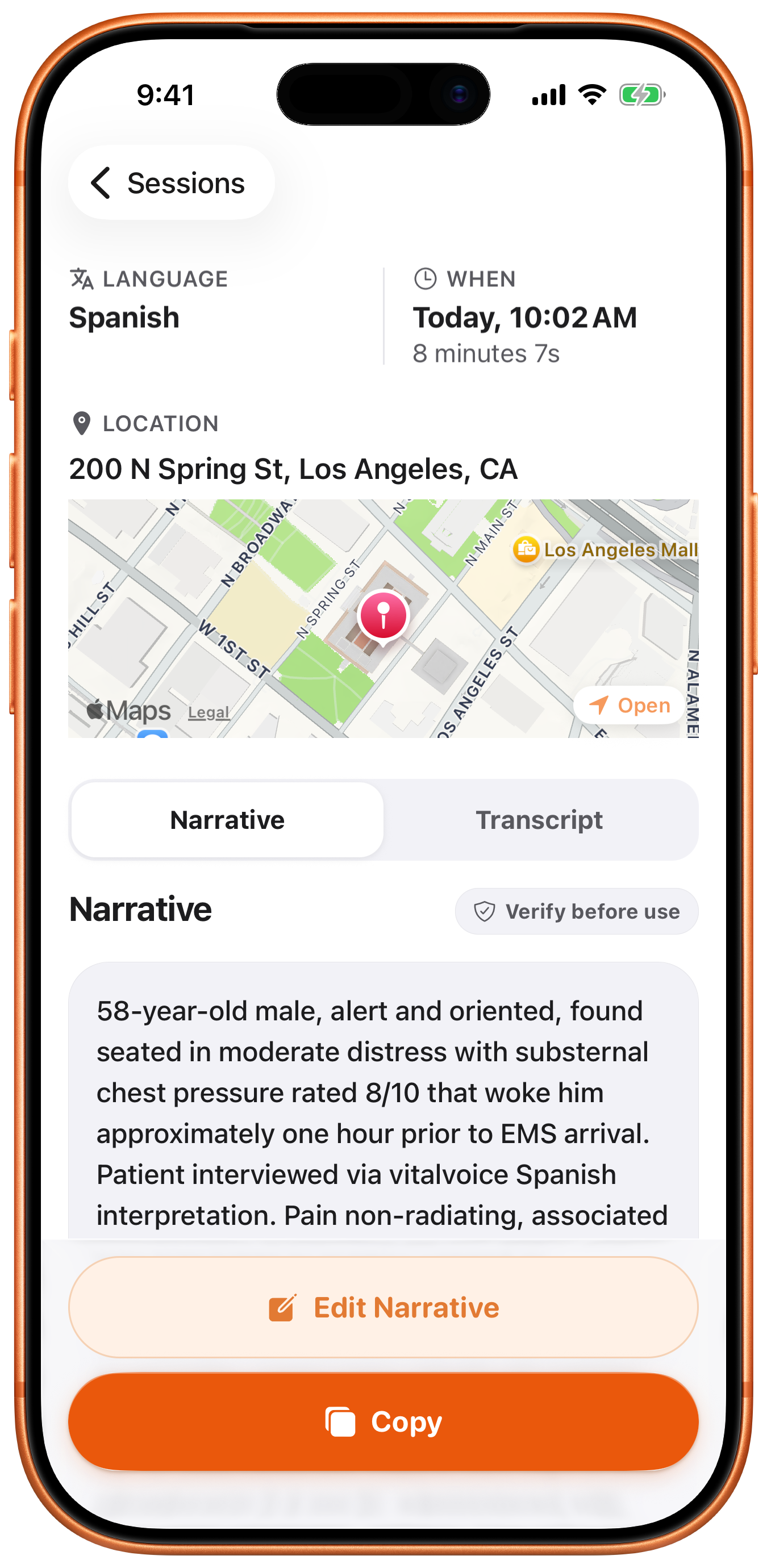
If you would rather speak your chart, Smart Dictation puts what you say into a narrative format. When a patient does not speak English, Translation works in 63 languages. It also works offline in basements and dead zones. That helps put the patient’s own words in the chart instead of a family member’s guess.
Transcripts stay on the device. They never reach our servers. They are erased at the end of your shift. vitalvoice is HIPAA-compliant, and your department gets a signed Business Associate Agreement (BAA).
Quick answers
How do you write an EMS narrative? Use your department’s format: SOAP, CHART, DCHART, or DRAATT. Fill each section with facts, times, quotes, and important signs you checked but did not find. Write what you saw and did. Do not make conclusions outside your role.
What should an EMS narrative example include? Include dispatch details and the chief complaint in the patient’s words. Add the history, assessment, vital signs and times, treatments, follow-up checks, transport, and handoff. The DCHART example above shows each part.
What’s the biggest PCR narrative mistake? Avoid vague filler such as “patient resting comfortably.” Also avoid writing the chart hours later from memory. Both can leave gaps that QA staff and attorneys notice.
Skip the blank page
Crews: Download vitalvoice from the App Store. You get two free sessions in each mode. Use one on your next call, then compare the draft with the chart you would have typed. Crews rate it 5.0.
Chiefs and training officers: CityEMT pilot crews gave vitalvoice a Net Promoter Score (NPS) of 95%. Book a 15-minute demo. We will start by showing you how a medic reviews, corrects, and signs each draft.