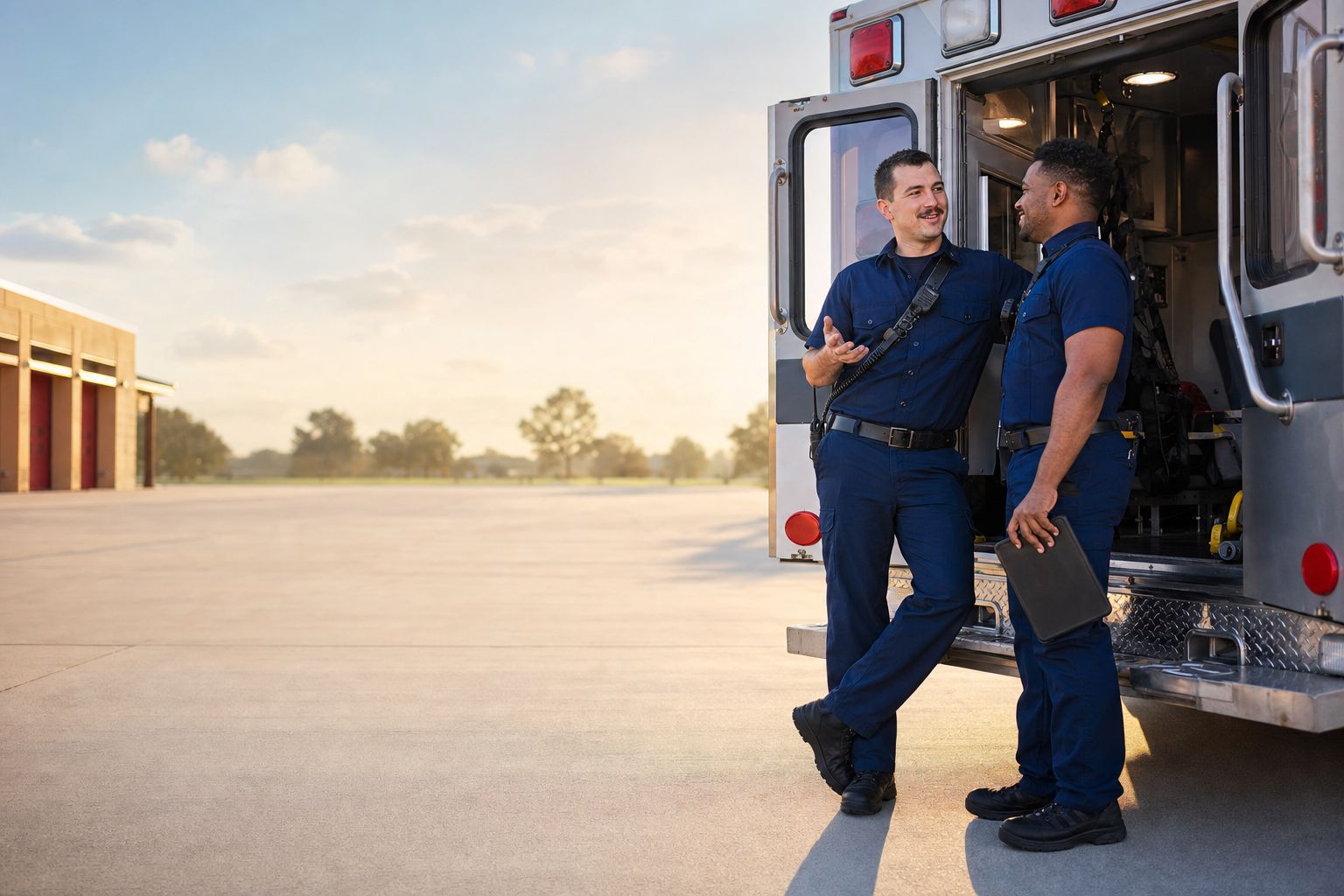
Focus on the scene.
Let vitalvoice.ai handle the documentation.
Built on the front lines of Fire & EMS, vitalvoice.ai was designed around how crews actually work in the field—not adapted from traditional healthcare software. From BLS and ALS calls to fire investigations, vitalvoice captures the encounter and drafts a department-specific narrative for your crew to review, edit, and approve.
Less time charting. More time ready for the next call.

Two free sessions in each mode. No sales call required.
In service with fire departments and EMS agencies






5.0
App Store rating
500+
First responders
93%
Choose it over the interpreter line
63
Languages
Watch it work
Watch the Demo
See how vitalvoice.ai captures a patient encounter, translates conversations, generates a narrative that matches your department's exact template, and prepares it for your ePCR.
What's in the app
One simple app. Use the mode you need.
Ambient Scribe, Smart Dictation, and Translation each solve a clear job. Roll out what your department needs without adding a heavyweight enterprise suite.
Ambient Scribe
Automatically writes the call
vitalvoice.ai listens during the patient encounter and creates a narrative in your department's exact template. Your crew reviews it, makes any changes, and signs off before it goes into the ePCR.
Learn moreSmart Dictation
Talk. Your report is written.
Need to write a refusal, patient care report, fire report, or inspection? Simply speak, and vitalvoice.ai creates a structured report with your department's sections, terminology, and rules.
Learn moreTranslation
Communicate in 63+ languages
Speak naturally. vitalvoice.ai detects the language, translates the conversation in real time, and can document the encounter at the same time—even without cellular service.
Learn moreDepartment Guides
Protocols at your fingertips
Department protocols, medication guides, and reference material are always available. Ask a question and get an answer without leaving the app.
How it works
Complete the call, not the paperwork.


1. Capture the call
Use Ambient Scribe, Smart Dictation, or Translation. vitalvoice.ai captures the patient encounter and starts building the report while your crew focuses on the patient.
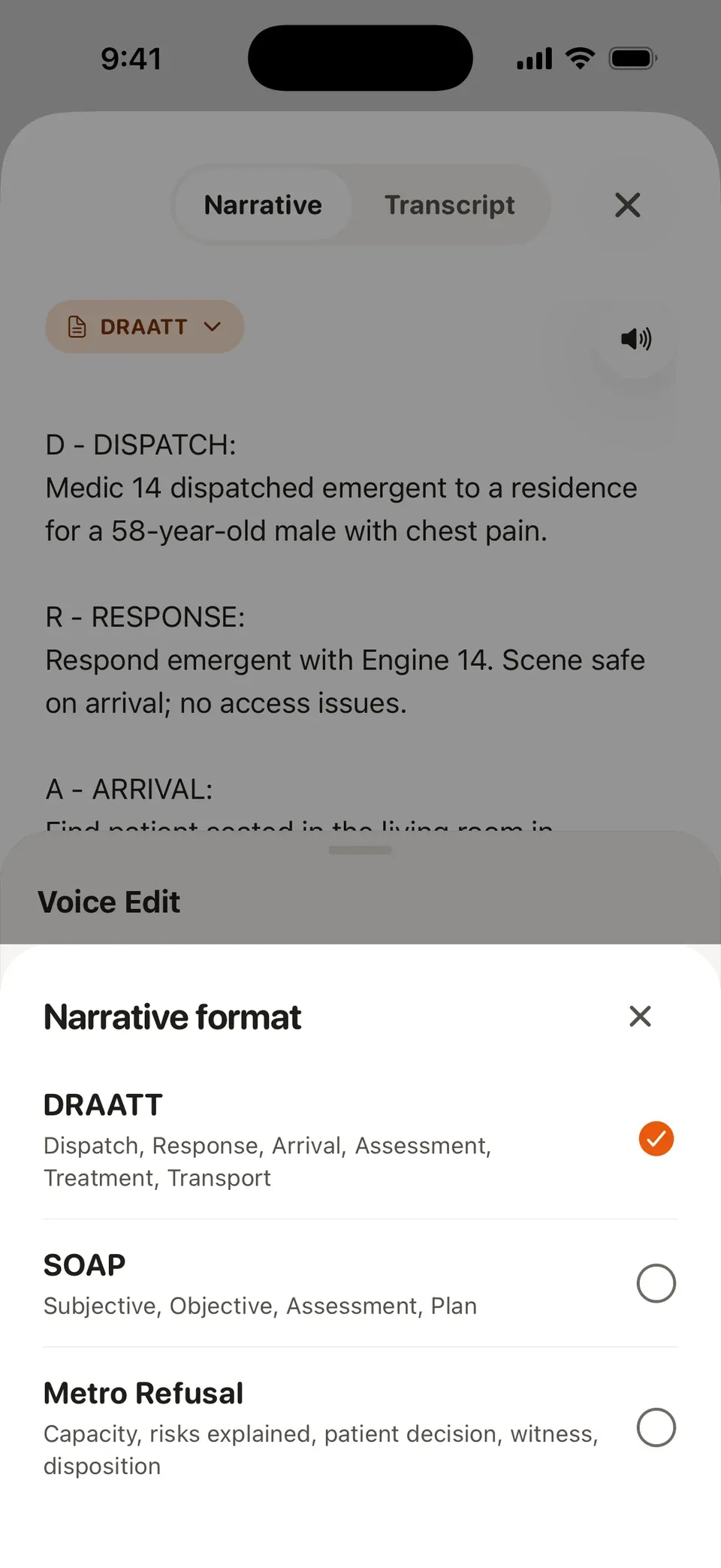
2. Match your template
Already have a narrative template? We configure vitalvoice.ai to match its sections, headings, terminology, and call-type rules. SOAP, CHART, DCHART, and DRAATT are starter formats only when your department does not already have one.
See how department templates work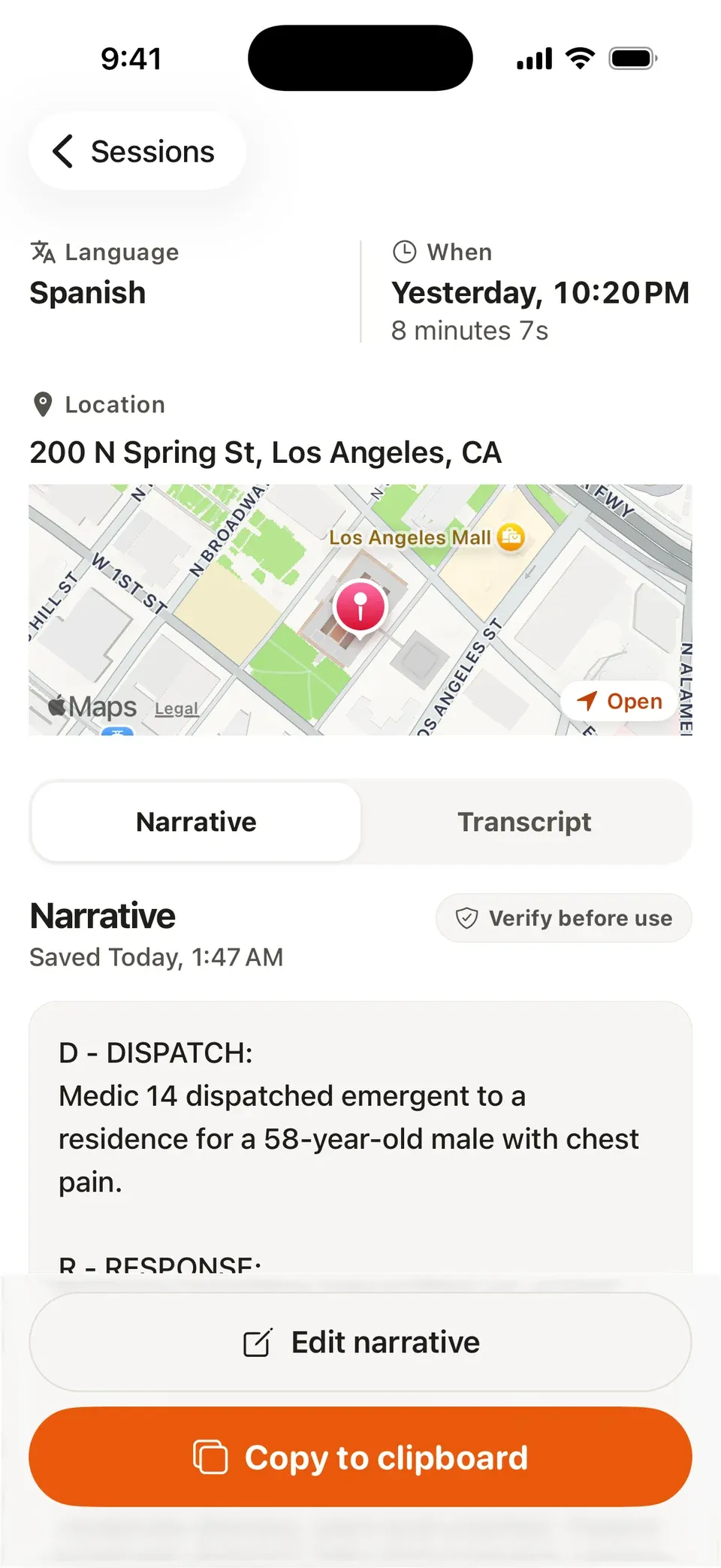
3. Review and submit
Review the report by voice or make changes manually. Once it's approved, copy it into your ePCR.
What it writes
From what was said to what gets filed.
vitalvoice.ai never invents facts. If it wasn't said on scene, it isn't in the draft.
Heard on scene
- 15:42 "Medic 3, respond to 100th and Potomac — bicyclist down, arm injury."
- 15:49 "What happened?" — "My front wheel hit the curb and I went down on my left side. Landed right on my arm."
- 15:50 "Swelling and deformity mid-forearm, skin's intact. Radial pulse is strong, cap refill under two."
- 15:51 "BP 132 over 84, heart rate 88, sat 99 on room air. Pain's an 8 of 10."
- 15:52 "Numbness or tingling in your fingers?" — "No." "Hit your head or black out?" — "No, I had my helmet on."
- 15:53 "Blood thinners or daily meds?" — "No, nothing."
The narrative
DCHART · TraumaD — DISPATCH: Medic 3 dispatched to the area of 100th and Potomac for a bicyclist down with a reported arm injury.
C — CHIEF COMPLAINT: Adult male with left forearm pain, rated 8/10, after a fall from his bicycle onto his left side.
H — HISTORY: Patient states his front wheel struck a curb, throwing him onto his left side and outstretched arm. Helmeted; denies head strike, loss of consciousness, numbness, or tingling. Denies anticoagulant use or daily medications.
A — ASSESSMENT: Obvious swelling and deformity to the mid-left forearm with skin intact. Radial pulse strong, capillary refill <2 seconds. Vitals: BP 132/84, HR 88, SpO₂ 99% RA…
Drafted before the rig cleared the scene. Reviewed by voice, signed by your medic.


And it's waiting on the rig iPad — every call, its narrative, and the scene, one tap from the ePCR.
Illustrative, de-identified example.
Built for the field
Made for the back of the rig, not the front office.
Built for the field
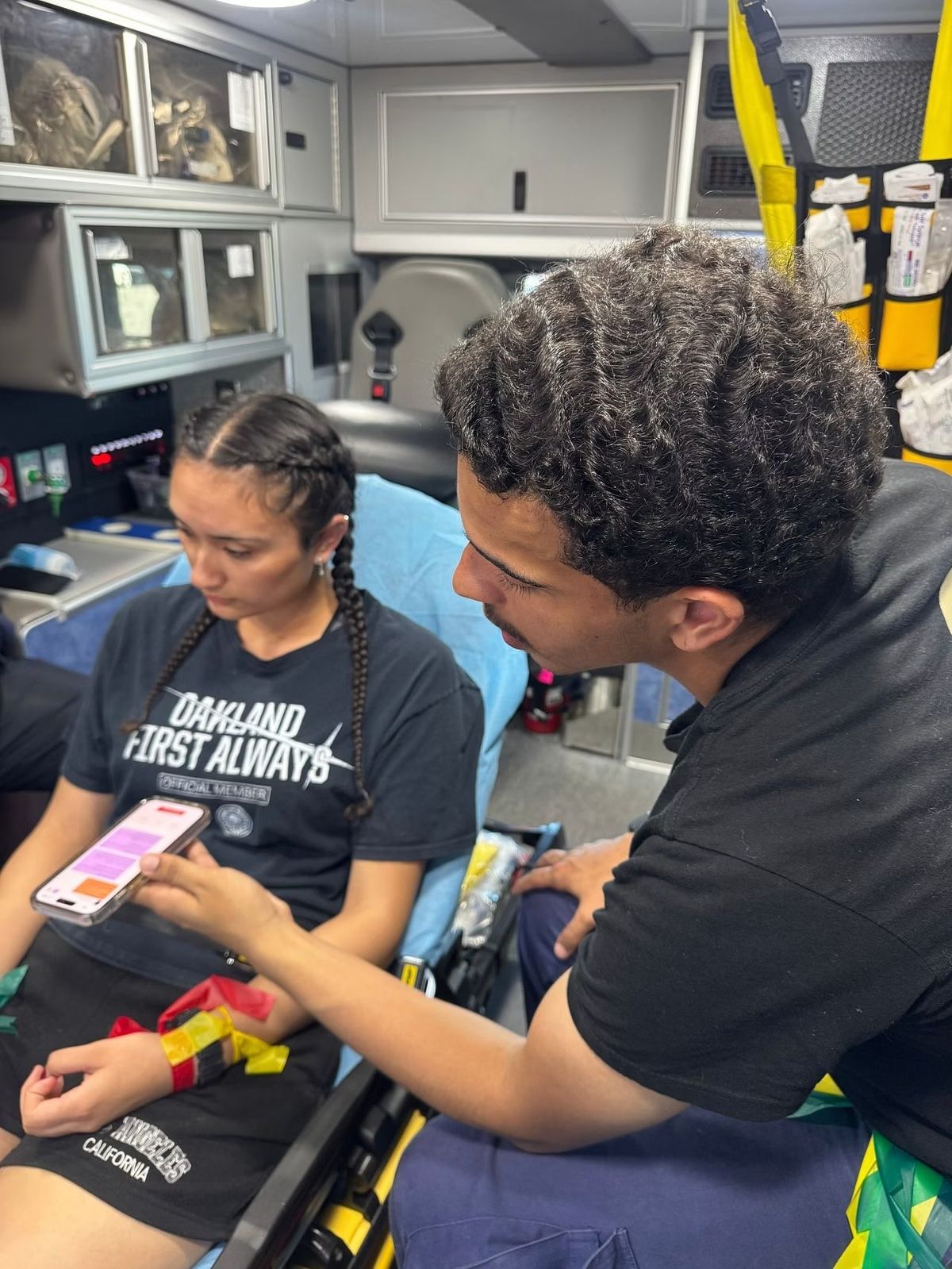
Large buttons. Simple screens. Easy to use with gloves, in bright sunlight, and on every call.
No signal? Still works.
Basements, rural highways, parking garages. Interpretation runs on-device, calls record offline, and guides live on the phone.
Department protocols
Keep your protocols and reference guides in one place. Search by keyword or ask a question to find what you need in seconds.
From the crews
Ask the people running it.
Ian Scott · Fire Medic
Brighton Fire Rescue District, CO
Dawson Deldotto · Paramedic Intern
Fairfield Fire Department, CA
"During the pilot, FFD crews used vitalvoice.ai 61 times… Crews reported high praise for the application overall, and as a result, FFD has now entered into an agreement with vitalvoice.ai."
For the chief
Your crews are already using AI.
Make it the kind you can defend.
Across the country, crews are pasting patient details into ChatGPT on personal phones to write their narratives. Personal accounts. No BAA. No audit trail. Every one of those charts is PHI leaving your department. vitalvoice.ai gives them a tool that's faster than the workaround — and compliant by design.
Never stored on our servers
Transcripts and narratives are kept on the device, encrypted, and wiped at the end of each shift. In online mode they're processed by our AI provider under a BAA with zero data retention, then discarded. We sign a Business Associate Agreement.
"If it isn't documented, it didn't happen."
Every session is timestamped and GPS-tagged. Every narrative is reviewed and signed by your medic. If that call comes back in two years, the record stands with your crew.
A tool they'll actually use
The workaround dies when the approved tool is better. Crews get their department's exact templates, offline mode, and a 5.0-rated app.
Pricing
Priced for department-wide adoption.
More capability does not mean enterprise-suite pricing. Departments receive a low, fixed price for the capabilities they choose.
Translation
No per-minute meter.
Predictable department pricing means crews can use interpretation whenever they need it without changing the bill after a busy month.
Scribe + Dictation
No running usage bill.
Documentation is included in the department's fixed quote. The price does not change when crews complete more reports.
“It's so darn simple to use and it's inexpensive to get into it.”
Questions chiefs ask
Straight answers.
Our crews just transport and let the hospital handle the language barrier.
Patient care starts on scene, not at the ER doors. That transport window is where injuries get missed and triage goes wrong. On one call, vitalvoice.ai caught that the patients were speaking Romanian — the crew fixed their triage on the spot. And without a real tool, the interpreter on scene is often the patient's scared kid. That's not a plan. That's a workaround.
Our crews already use Google Translate — or ChatGPT.
That's exactly the problem. Pasting patient details into ChatGPT on a personal phone is a HIPAA breach: personal account, no BAA, no audit trail. It works right up until a records request or a deposition. vitalvoice.ai does the same job — in your department's own narrative format — with patient data that's never stored on our servers, and never leaves the device at all in offline mode.
How do I know the AI is accurate?
vitalvoice.ai never invents facts. If it wasn't said on scene, it isn't in the draft. Your medic reviews every narrative and signs off before it touches the ePCR. Every session leaves a timestamped record you can go back to — more accountability than a phone interpreter who leaves no trace. And your own crews validate it during the pilot.
Do we have to use SOAP, CHART, DCHART, or DRAATT?
No. If your department already has a narrative template, we configure vitalvoice.ai to match it section by section, heading by heading, down to required terminology and call-type rules. SOAP, CHART, DCHART, and DRAATT are starter formats for departments that do not already have a defined template.
We already have a contract with a phone interpreter line.
Keep it — run vitalvoice.ai alongside it during the pilot. When crews have both, 93% choose vitalvoice.ai. Translation uses predictable department pricing instead of a per-minute meter, so most departments replace the line at renewal.
Does doing more make vitalvoice.ai expensive or complicated?
No. Crews choose one clear mode—Ambient Scribe, Smart Dictation, or Translation—from one simple app, and departments can roll out the modes they need. Departments receive a low, fixed price for the capabilities they choose, with no running usage meter.
What will my compliance officer say?
Probably: finally. Transcripts stay on the phone — they never sync to our servers — and wipe automatically at the end of each shift. We sign a Business Associate Agreement. Departments in Colorado and California have already cleared vitalvoice.ai with their compliance officers.
How hard is rollout?
There's no required hardware and no large IT project. It's an iOS app. We configure your exact narrative templates and protocols, get it onto your crews' phones, and ride along on real calls to make sure it sticks. Most departments are running it within a week.
Coming soon
Relay.
Clip it on. Run the call.
vitalvoice.ai hardware that rides on the radio strap. It captures the call where your medic stands, holds it through dead zones — and once you're back at the rig, the charts write themselves.
Relay is optional. The vitalvoice.ai iOS app works on its own with no new hardware.
In development with our pilot departments. Ask about early access on your demo.
See a call become a chart.
No hardware, no IT project. Your crews can be running vitalvoice.ai this week — and we ride along to make sure it works.
Two free sessions in each mode. No sales call required.
or email us at hello@vitalvoice.ai